how to draw points on a 3d coordinate system
Show Mobile Notice Show All NotesHibernate All Notes
Mobile Notice
Yous appear to be on a device with a "narrow" screen width (i.e. you are probably on a mobile phone). Due to the nature of the mathematics on this site it is best views in mural manner. If your device is non in mural fashion many of the equations will run off the side of your device (should be able to whorl to see them) and some of the menu items will be cut off due to the narrow screen width.
Section 1-i : The 3-D Coordinate Arrangement
We'll showtime the affiliate off with a fairly brusk discussion introducing the 3-D coordinate organization and the conventions that we'll be using. We volition also take a brief look at how the unlike coordinate systems can alter the graph of an equation.
Let's first become some basic notation out of the way. The 3-D coordinate system is often denoted by \({\mathbb{R}^3}\). Likewise, the 2-D coordinate system is often denoted by \({\mathbb{R}^2}\) and the 1-D coordinate organization is denoted by \(\mathbb{R}\). Also, every bit you lot might have guessed then a general \(northward\) dimensional coordinate arrangement is often denoted by \({\mathbb{R}^n}\).
Next, allow's take a quick look at the basic coordinate system.
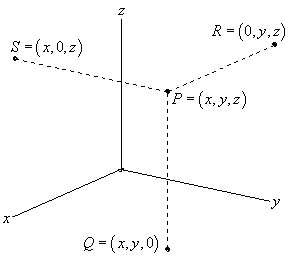
This is the standard placement of the axes in this class. It is assumed that only the positive directions are shown past the axes. If we demand the negative axes for any reason we volition put them in as needed.
Besides note the various points on this sketch. The point \(P\) is the general point sitting out in 3-D space. If we get-go at \(P\) and drop straight down until nosotros attain a \(z\)-coordinate of cipher nosotros arrive at the point \(Q\). We say that \(Q\) sits in the \(xy\)-plane. The \(xy\)-airplane corresponds to all the points which have a zero \(z\)-coordinate. We tin also commencement at \(P\) and movement in the other two directions equally shown to get points in the \(xz\)-plane (this is \(Due south\) with a \(y\)-coordinate of zero) and the \(yz\)-airplane (this is \(R\) with an \(x\)-coordinate of zero).
Collectively, the \(xy\), \(xz\), and \(yz\)-planes are sometimes called the coordinate planes. In the remainder of this form yous will need to be able to deal with the various coordinate planes so make sure that you lot can.
Also, the indicate \(Q\) is often referred to equally the projection of \(P\) in the \(xy\)-plane. Besides, \(R\) is the projection of \(P\) in the \(yz\)-aeroplane and \(S\) is the projection of \(P\) in the \(xz\)-plane.
Many of the formulas that you lot are used to working with in \({\mathbb{R}^ii}\) have natural extensions in \({\mathbb{R}^3}\). For instance, the distance betwixt two points in \({\mathbb{R}^2}\) is given by,
\[d\left( {{P_1},{P_2}} \right) = \sqrt {{{\left( {{x_2} - {x_1}} \correct)}^ii} + {{\left( {{y_2} - {y_1}} \right)}^2}} \]
While the altitude between any 2 points in \({\mathbb{R}^3}\) is given by,
\[d\left( {{P_1},{P_2}} \right) = \sqrt {{{\left( {{x_2} - {x_1}} \right)}^2} + {{\left( {{y_2} - {y_1}} \right)}^two} + {{\left( {{z_2} - {z_1}} \right)}^2}} \]
Likewise, the general equation for a circle with center \(\left( {h,k} \correct)\) and radius \(r\) is given by,
\[{\left( {ten - h} \correct)^2} + {\left( {y - k} \right)^2} = {r^2}\]
and the full general equation for a sphere with center \(\left( {h,grand,l} \correct)\) and radius \(r\) is given by,
\[{\left( {x - h} \right)^2} + {\left( {y - grand} \correct)^2} + {\left( {z - l} \right)^two} = {r^two}\]
With that said nosotros practice demand to exist careful about just translating everything nosotros know almost \({\mathbb{R}^ii}\) into \({\mathbb{R}^3}\) and assuming that information technology will work the aforementioned way. A good example of this is in graphing to some extent. Consider the following example.
Instance 1 Graph \(x = three\) in \(\mathbb{R}\), \({\mathbb{R}^2}\) and \({\mathbb{R}^3}\).
Show Solution
In \(\mathbb{R}\) we have a single coordinate system and so \(10 = 3\) is a bespeak in a ane-D coordinate arrangement.
In \({\mathbb{R}^ii}\) the equation \(ten = 3\) tells united states of america to graph all the points that are in the class \(\left( {iii,y} \right)\). This is a vertical line in a 2-D coordinate system.
In \({\mathbb{R}^3}\) the equation \(x = three\) tells united states of america to graph all the points that are in the form \(\left( {3,y,z} \correct)\). If you lot go back and await at the coordinate plane points this is very similar to the coordinates for the \(yz\)-aeroplane except this time we have \(x = 3\) instead of \(ten = 0\). So, in a three-D coordinate organization this is a plane that volition be parallel to the \(yz\)-plane and pass through the \(x\)-axis at \(ten = iii\).
Here is the graph of \(x = iii\) in \(\mathbb{R}\).

Here is the graph of \(ten = 3\) in \({\mathbb{R}^2}\).

Finally, here is the graph of \(x = 3\) in \({\mathbb{R}^3}\). Note that nosotros've presented this graph in two unlike styles. On the left we've got the traditional axis organization that we're used to seeing and on the right we've put the graph in a box. Both views can exist convenient on occasion to aid with perspective and so we'll often do this with 3D graphs and sketches.
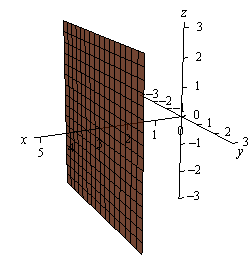

Note that at this point nosotros can now write down the equations for each of the coordinate planes as well using this idea.
\[\begin{align*}z & = 0\hspace{0.25in}\hspace{0.25in}xy - {\mbox{airplane}}\\ y & = 0\hspace{0.25in}\hspace{0.25in}xz - {\mbox{plane}}\\ x & = 0\hspace{0.25in}\hspace{0.25in}yz - {\mbox{plane}}\end{marshal*}\]
Allow's take a look at a slightly more than general instance.
Example 2 Graph \(y = 2x - 3\) in \({\mathbb{R}^2}\) and \({\mathbb{R}^3}\).
Show Solution
Annotation we had to throw out \(\mathbb{R}\) for this example since there are two variables which means that we tin can't be in a ane-D space (1-D space has only one variable!).
In \({\mathbb{R}^2}\) this is a line with slope 2 and a \(y\) intercept of -iii.
Nevertheless, in \({\mathbb{R}^three}\) this is non necessarily a line. Considering we accept not specified a value of \(z\) we are forced to let \(z\) take any value. This means that at any particular value of \(z\) nosotros will get a re-create of this line. And then, the graph is then a vertical plane that lies over the line given by \(y = 2x - three\) in the \(xy\)-airplane.
Here is the graph in \({\mathbb{R}^ii}\).

hither is the graph in \({\mathbb{R}^3}\).

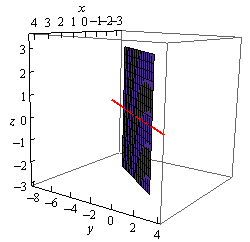
Notice that if we expect to where the plane intersects the \(xy\)-plane nosotros volition go the graph of the line in \({\mathbb{R}^2}\) as noted in the above graph by the red line through the airplane.
Allow's take a look at i more example of the difference betwixt graphs in the dissimilar coordinate systems.
Instance 3 Graph \({x^2} + {y^2} = 4\) in \({\mathbb{R}^2}\) and \({\mathbb{R}^3}\).
Bear witness Solution
Every bit with the previous example this won't have a ane-D graph since at that place are two variables.
In \({\mathbb{R}^2}\) this is a circle centered at the origin with radius 2.
In \({\mathbb{R}^3}\) however, as with the previous example, this may or may not be a circle. Since nosotros have not specified \(z\) in whatsoever manner we must assume that \(z\) can take on whatever value. In other words, at any value of \(z\) this equation must exist satisfied and then at any value \(z\) we have a circle of radius 2 centered on the z-axis. This ways that nosotros have a cylinder of radius 2 centered on the \(z\)-axis.
Here are the graphs for this example.

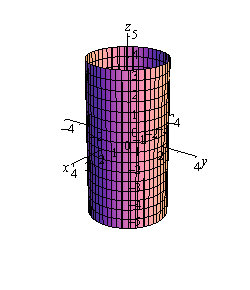

Notice that again, if nosotros look to where the cylinder intersects the \(xy\)-plane nosotros will again get the circle from \({\mathbb{R}^2}\).
We need to be conscientious with the last 2 examples. It would be tempting to have the results of these and say that nosotros can't graph lines or circles in \({\mathbb{R}^three}\) and yet that doesn't really make sense. There is no reason for there to not be graphs of lines or circles in \({\mathbb{R}^3}\). Let'southward retrieve most the example of the circumvolve. To graph a circle in \({\mathbb{R}^3}\) we would need to practice something like \({x^2} + {y^2} = 4\) at \(z = five\). This would be a circumvolve of radius ii centered on the \(z\)-axis at the level of \(z = five\). So, as long equally nosotros specify a \(z\) we volition become a circumvolve and non a cylinder. We will see an easier way to specify circles in a later section.
We could exercise the same thing with the line from the 2nd example. However, we volition exist looking at lines in more than generality in the side by side section and and then nosotros'll see a improve way to bargain with lines in \({\mathbb{R}^3}\) there.
The point of the examples in this department is to brand sure that nosotros are being careful with graphing equations and making sure that we always remember which coordinate system that we are in.
Another quick point to make here is that, as we've seen in the above examples, many graphs of equations in \({\mathbb{R}^three}\) are surfaces. That doesn't mean that we can't graph curves in \({\mathbb{R}^three}\). We can and will graph curves in \({\mathbb{R}^3}\) likewise equally we'll see later in this chapter.
seaveywhisingerrim1994.blogspot.com
Source: https://tutorial.math.lamar.edu/classes/calciii/3dcoords.aspx

Post a Comment for "how to draw points on a 3d coordinate system"