what happened to the money hillary was paid for goldman sachs talks?
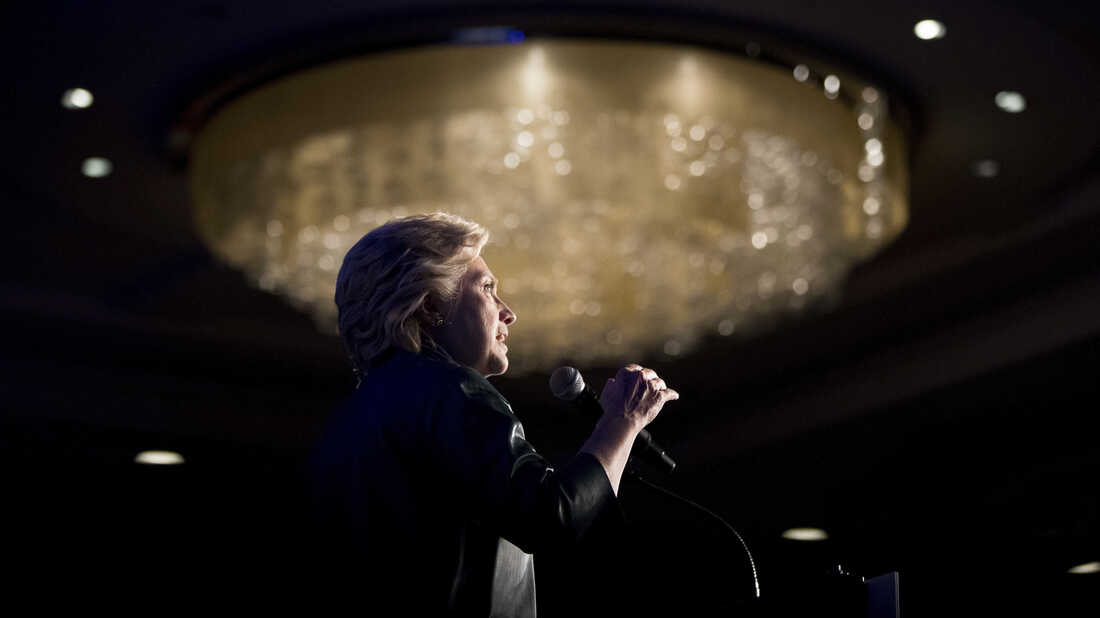
Autonomous presidential candidate Hillary Clinton speaks at a fundraiser in Washington, D.C., on Oct. 5. Andrew Harnik/AP hide caption
toggle caption
Andrew Harnik/AP

Autonomous presidential candidate Hillary Clinton speaks at a fundraiser in Washington, D.C., on Oct. v.
Andrew Harnik/AP
After resisting months of calls from Bernie Sanders and others to release the transcripts of her speeches to Wall Street banks, some of Hillary Clinton'due south full remarks are apparently now available for all to see, with but weeks until Election Day.
We say "apparently" because the transcripts were published past WikiLeaks as part of its ongoing release of emails hacked from Clinton campaign chairman John Podesta's personal Gmail account. The Clinton campaign is refusing to verify the authenticity of whatever of the documents, which it describes as stolen.
The transcript are found in a Jan 2016 email from Clinton campaign enquiry manager Tony Carrk to Podesta and other top Clinton advisers with the glaring discipline line: "Goldman Sachs Paid Speeches."
Attached to it are what appear to be transcripts of iii paid appearances Clinton fabricated at events held past the investment banking firm in 2013.
Clinton earned millions of dollars giving paid speeches in the time betwixt her tenure at the State Department and her campaign for president, simply it was the $675,000 she earned speaking to Goldman Sachs that attracted the most attention and ire.
During the Democratic primary, Sanders made mocking her highly paid speeches a regular part of his stump speech.
"If you're going to give a speech for $225,000 it's gotta exist really, don't you call up an extraordinarily brilliant spoken language," Sanders said to roars of laughter and thank you from a oversupply in Appleton, Wis. "I hateful why else would they pay that kind of money? And information technology must exist a oral communication which will open up the optics of the world, transform our country. Must be a speech communication written in Shakespearean prose. And so I think, if it is such a fantastic speech, the Secretarial assistant should arrive available to all of united states."
Now everyone can approximate for themselves whether Clinton'due south words were transformative, Shakespearean, or just sort of mundane.
And information technology turns out they weren't actually speeches in the traditional sense. Instead, they appear to exist extended Q-and-A'south with Goldman Sachs executives, sometimes taking questions from others also.
The entire transcripts are below.
Clinton On Dodd-Frank
The part of her remarks most likely to exist politically problematic concern fiscal industry regulation. In an Oct., 2013, discussion with Tim O'Neill, who is the co-head of investment management at Goldman Sachs, Clinton appears to suggest the impetus for the Dodd–Frank Wall Street reform legislation was at least partially "for political reasons." President Obama signed the law in 2010 and Clinton supported it and so, equally she does now.
Clinton besides is said to have remarked, "There's nothing magic near regulations, as well much is bad, as well niggling is bad."
In the transcripts released Saturday, Clinton explains:
"There was a lot of complaining almost Dodd-Frank, only there was also a need to do something because, for political reasons, if you were an elected member of Congress and people in your constituency were losing jobs and shutting businesses and everybody in the press is saying it's all the error of Wall Street, you can't sit idly past and do nothing, but what you exercise is really important."
Clinton also said that "there are and then many places in the country where the banks are not doing what they need to practice because they're scared of regulations, they're scared of the other shoe dropping."
This is far softer language than Clinton uses on the campaign trail. She often praises Dodd-Frank and says she wants it strengthened. And in a 2015 New York Times op-ed titled "How I'd Rein In Wall Street," Clinton was much tougher on Wall Street reform than she was behind closed doors, saying, "As president, I would not merely veto any legislation that would weaken fiscal reform, but I would also fight for tough new rules, stronger enforcement and more accountability that go well across Dodd-Frank."
Here is that section of the transcript in full:
MR. O'NEILL: Let's come back to the US. Since 2008, at that place's been an awful lot of seismic activity around Wall Street and the big banks and regulators and politicians. Now, without going over how we got to where we are right now, what would exist your advice to the Wall Street community and the big banks equally to the way forward with those 2 important decisions?
Secretarial assistant CLINTON: Well, I represented all of you for 8 years. I had bully relations and worked then close together afterwards ix/eleven to rebuild downtown, and a lot of respect for the piece of work yous do and the people who do it, but I do — I think that when we talk about the regulators and the politicians, the economic consequences of bad decisions back in '08, you know, were devastating, and they had repercussions throughout the globe.
That was one of the reasons that I started traveling in February of '09, and so people could, you know, literally yell at me for the United States and our banking system causing this everywhere. Now, that's an oversimplification we know, only it was the conventional wisdom.
And I call back that there's a lot that could have been avoided in terms of both misunderstanding and really politicizing what happened with greater transparency, with greater openness on all sides, you know, what happened, how did information technology happen, how do we prevent information technology from happening? Y'all guys help us figure it out and let'due south brand sure that we practice it right this time.
And I recall that everybody was desperately trying to fend off the worst effects institutionally, governmentally, and there just wasn't that opportunity to try to sort this out, and that came later.
I hateful, information technology'southward still happening, as yous know. People are looking back and trying to, yous know, get bounty for bad mortgages and all the balance of information technology in some of the agreements that are being reached.
There's nothing magic well-nigh regulations, too much is bad, too little is bad. How do you get to the golden key, how exercise we figure out what works?And the people that know the manufacture meliorate than anybody are the people who work in the manufacture.
And I recollect there has to be a recognition that, you know, there's so much at stake now, I mean, the business has inverse so much and decisions are made so quickly, in nano seconds basically. Nosotros spend trillions of dollars to travel around the globe, only it's in everybody's interest that nosotros have a better framework, and not just for the The states but for the unabridged world, in which to operate and merchandise.
You know, I remember having a long conversation with Warren Buffett, who is plainly a friend of mine, only I think he's the greatest investor of our modernistic era, and he said, you know, I would go and I'd talk to my friends and I'd inquire them to explicate to me what a default credit swap was, and by the time they got into their fifth minute, I had no idea what they were talking about.And when they got into their tenth minute, I realized they didn't have any idea what they were talking about.
I hateful, Alan Greenspan said, I didn't understand at all what they were trading. So I think information technology's in everybody's interest to get back to a better transparent model.
And nosotros demand cyberbanking. I mean, right now, at that place are so many places in our state where the banks are not doing what they need to do because they're scared of regulations, they're scared of the other shoe dropping, they're just plain scared,and then credit is not flowing the way it needs to to restart economic growth.
Then people are, you know, a piffling --they're all the same uncertain, and they're uncertain both because they don't know what might come next in terms of regulations, but they're likewise uncertain considering of changes in a global economy that we're only offset to take concord of.
So first and foremost, more transparency,more than openness, you know, trying to figure out, we're all in this together, how we go along this incredible economic engine in this state going. And this is, you know, the fretfulness, the spinal cavalcade.
And with political people, again, I would say the same matter, you know, there was a lot of lament about Dodd-Frank, only there was also a need to practise something considering for political reasons, if you lot were an elected member of Congress and people in your constituency were losing jobs and shutting businesses and everybody in the printing is saying information technology's all the fault of Wall Street, you tin't sit idly by and do nothing, but what yous do is really important.
And I remember the jury is notwithstanding out on that because it was very hard to sort of sort through it all.
And, of form, I don't, you know, I know that banks and others were worried about connected liability and other problems downward the road, so it would be ameliorate if nosotros could have had a more open up exchange about what we needed to do to fix what had broken and then attempt to make sure information technology didn't happen again, but we will go along working on information technology.
MR. O'NEILL: By the mode, we actually did capeesh when you were the senator from New York and your continued involvement in the issues (inaudible) to exist mettlesome in some respects to associated with Wall Street and this surroundings. Thank you very much.
Secretary CLINTON: Well, I don't feel particularly courageous. I mean, if we're going to be an constructive, efficient economy, we demand to have all part of that engine running well, and that includes Wall Street and Main Street.
And in that location's a big disconnect and a lot of confusion right at present. So I'm non interested in, y'all know, turning the clock back or pointing fingers, but I am interested in trying to effigy out how we come together to chart a better mode frontwards and ane that will restore confidence in, yous know, small-scale and medium-size businesses and consumers and brainstorm to chip abroad at the unemployment charge per unit.
And so it'southward something that I, yous know, if you're a realist, you know that people take different roles to play in politics, economics, and this is an important role, but I practise recall that in that location has to be an understanding of how what happens here on Wall Street has such broad consequences not simply for the domestic but the global economic system, so more thought has to exist given to the process and transactions and regulations then that nosotros don't kill or maim what works, but nosotros concentrate on the most effective fashion of moving forward with the brainpower and the financial power that exists here.
Clinton on President Obama'due south Ability To Work With Congress
In the midst of a discussion about the Affordable Intendance Deed, O'Neill asks Clinton about President Obama. Her response seems less than a full-throated defence force of a president who's been criticized as aloof.
Do you think that if he were more personally engaged with Congress on these issues, that we would take a different result?
SECRETARY CLINTON: I don't know, Tim. I mean, I've obviously been asked this and I've seen the critique. You know, unlike presidents take different strengths, they bring different life experiences.
I had the opportunity of working with the President closely for four years on some very tough national security issues. He'southward an incredibly intelligent, thoughtful, decisive person in pursuing the calendar he sets.
But he may not, you know, be someone who we recall of as spending a lot of time in a requite and take of politics; however, I know that he spent a lot of fourth dimension early on in the offset term with the Republicans in trying, as you lot retrieve, to put together the [grand deal] and it turned out that the Republicans' side, particularly in the house, couldn't deliver on fifty-fifty a small [bargain].
Clinton Gets Asked Well-nigh Running for President
On more than i occasion, Clinton is asked in diverse ways about whether she will run for president. The way she describes the prospect in October of 2013 is downright idealistic when compared to the presidential race she is now in the midst of.
MR. O'NEILL: So last question, if --what would yous advise someone if he or she came to you and said, I'thousand thinking about running for the Autonomous presidential nomination?
SECRETARY CLINTON: Another 1 of those hypotheticals. Well, I would probably say, are you crazy?
MR. O'NEILL: Wait, await. Secretary CLINTON: Look, I call up whoever runs next time has to have a very articulate thought of where he or she wants to take the country and has to run on those ideas, considering the election cannot exist about personalities, participants sniping, all of the irrelevant stuff the solar day subsequently the election sort of dissipates, and you wake up and say, okay, now what am I going to practice?
It needs to be an ballot about the hereafter. So win or lose, people know what yous want to do. Yous took it to the country, you tried to build a consensus for it, which can hopefully avoid some of the finish runs that we've been seeing in the terminal few weeks, and then yous have to have plenty of an understanding of how government works to be able to execute the operational side of it, the slow, hard dull of hard boards every bit (inaudible) said about politics, there's zero glamorous about it.
Clinton On Political Compromise
During a June, 2013, Q-and-A led past Goldman Sachs CEO Lloyd Blankfein, Clinton was asked by an audience fellow member what she thought has to be washed to become "America back to a functional government." This was simply months before the regime shutdown, just information technology is also a question Clinton will have to wrestle with if she wins the ballot.
Clinton argued for a render to an earlier brand of politics, where compromise was a virtue. "The compromise may not be perfect," Clinton said. "In fact, it rarely is, but information technology represents the big thinking and the political will that is currently available in order to make a conclusion."
She went on, arguing that elected officials who put party above all shouldn't keep their jobs.
"And I don't intendance if y'all're a liberal icon or a conservative icon," Clinton said. "If you are not willing to exist active in your republic and do what is necessary to deal with our problems, I recall y'all should be voted out. I think you should only be voted out, and I would like to meet more people saying that."
Clinton On The Political Press
In that same June chat, Clinton didn't exactly hibernate her disdain for political reporters, complaining "our political press has just been captured past trivia."
In the transcript, Clinton continues, "And so you don't want to give them whatsoever more than time to trivialize the importance of the bug than you lot have to give them."
Clinton on WikiLeaks
In an October 29, 2013, conversation with Lloyd Blankfein, the topic of WikiLeaks comes upwards. Clinton points out she was secretary of state when the NSA documents about surveillance techniques used past the U.S. intelligence community were released.
Secretary CLINTON: Okay. I was Secretary of State when WikiLeaks happened. You lot remember that whole debacle. So out come hundreds of thousands of documents. And I have to keep an apology bout. And I had a jacket made like a rock star tour. The Clinton Amends Tour.
I had to go and apologize to everyone who was in any mode characterized in any of the cables in any manner that might be considered less than flattering. And it was painful. Leaders who shall remain nameless, who were characterized every bit vain, egotistical, power hungry --
MR. BLANKFEIN: Proved it.
Secretarial assistant CLINTON: — corrupt. And we knew they were. This was not fiction. And I had to go and say, yous know, our ambassadors, they go carried away, they desire to all be literary people. They go off on tangents. What can I say. I had grown men cry. I mean, literally. I am a friend of America, and you say these things well-nigh me.
MR. BLANKFEIN: That'southward an Italian accent. Secretary CLINTON: Have a sense of humor.
MR. BLANKFEIN: And and then yous said, Silvio. (Laughter.)
Clinton On Concern People Running For Role
In remarks that might seem ironic in hindsight, Clinton at that issue said she liked the idea of people with business concern feel running for office.
MALE ATTENDEE: My question is, as entrepreneurs, we hazard a lot. And Mike Bloomberg had xxx billion other reasons than to take part. Do we need a wholesale modify in Washington that has more to do with people that don't need the job than accept the job?
Secretary CLINTON: That's a really interesting question. You know, I would like to run into more than successful business organisation people run for office. I really would like to see that considering I do call up, you know, you don't have to have 30 billion, but you accept a certain level of freedom. And at that place's that memorable phrase from a former member of the Senate: You can be mayhap rented merely never bought.
And I think it'southward of import to have people with those experiences. And especially now, because many of you in this room are on the cutting border of technology or health care or some other segment of the economy, and so yous are people who look over the horizon. And coming into public life and bringing that perspective likewise equally the success and the insulation that success gives you could really help in a lot of our political situations right at present.
Meg Anderson contributed to this report.
seaveywhisingerrim1994.blogspot.com
Source: https://www.npr.org/2016/10/15/498085611/wikileaks-claims-to-release-hillary-clintons-goldman-sachs-transcripts

Post a Comment for "what happened to the money hillary was paid for goldman sachs talks?"